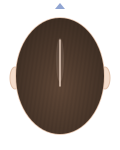
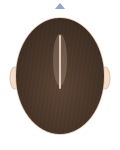
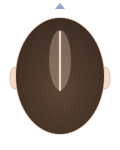
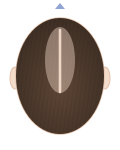
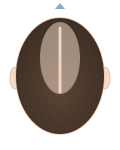
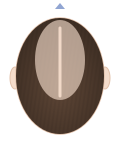
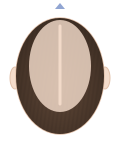
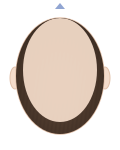
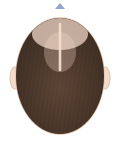
You can get a rough idea of your stage at home by comparing your hair with the illustrations in the stage viewer above. For the most useful comparison:
The illustrations only explain the general classification. They cannot diagnose the type or cause of your hair loss. A doctor also looks at the donor area, the thickness of each hair, the health of the scalp and your medical history.
Higher stages usually involve a larger area, so they often need more grafts. However, the stage is only one of several factors:
At Esvita Clinic, a single DHI session can transplant up to 4,000 grafts and a Sapphire FUE session up to 5,500 grafts, when the donor area allows. These are clinic capacities, not targets for every patient. Your doctor confirms the number of grafts after examining your scalp.
What is the Norwood Scale?
The Norwood scale, also called the Hamilton-Norwood scale, is a classification system for male pattern hair loss. It describes seven main stages, based on how far the hairline has receded and how much the crown has thinned, plus variants such as Norwood 3 Vertex.
What are the seven stages of male pattern hair loss?
Stage 1 has little or no recession, Stage 2 shows mild recession at the temples and Stage 3 shows deeper recession, often with an M-shaped hairline. Stages 4 and 5 show growing loss at the front and crown, Stage 6 joins these areas, and Stage 7 leaves only a band of hair at the sides and back.
What is the difference between Norwood Stage 2 and Stage 3?
In Stage 2, the temples recede only slightly. In Stage 3, the recession is deeper and clearly visible, often creating an M or U-shaped hairline, and it is usually considered the first stage of clinically significant hair loss.
What does Norwood Stage 3 hair loss look like?
Norwood 3 shows a clear recession at both temples, while the centre of the hairline may still be in place. The result is often an M-shaped hairline.
What is Norwood Stage 3 Vertex?
Norwood 3 Vertex is Stage 3 recession at the hairline combined with thinning on the crown. Treatment planning has to consider both areas and how the available grafts are shared between them.
What is the difference between Norwood Stage 4 and Stage 5?
In both stages, hair is lost at the front and on the crown. In Stage 4, a clear band of hair still separates these areas; in Stage 5, this band becomes narrower and thinner.
Can Norwood Stage 5 or Stage 6 hair loss be treated?
Often, yes, if the donor area is strong enough. The plan may need a large number of grafts or more than one session, and it usually focuses on the areas that change the appearance most.
Is a hair transplant possible at Norwood Stage 7?
Sometimes. It depends on the density and size of the remaining donor area. Full coverage of the top of the head is often not realistic at this stage, so expectations should be discussed carefully with a doctor.
How many grafts are needed for each Norwood stage?
There is no fixed number for each stage. As a general guide, Norwood 2 often falls around 800 to 1,500 grafts, Norwood 3 around 1,500 to 2,500, Norwood 4 around 2,500 to 3,500 and Norwood 5 around 3,000 to 4,500, when the usual areas for that stage are treated. Your own number depends on the area to be treated, your donor capacity, your hair characteristics and the density you want. You can explore an estimate with our hair transplant graft calculator.
Can the Norwood Scale predict future hair loss?
No. It describes your current stage, not how fast or how far your hair loss will progress. Age, family history and response to medical treatment give more information about the future.
What is the Ludwig Scale for female hair loss?
The Ludwig scale classifies female pattern hair loss based on thinning on the top of the head. The original scale has three stages; the extended version splits them into I-1 to I-4, II-1, II-2 and III, and adds an advanced stage and a frontal pattern. Unlike male pattern hair loss, the frontal hairline is usually kept.
What are the three stages of female pattern hair loss?
Ludwig 1 is mild thinning with a slightly wider parting (I-1 to I-4 in the extended scale). Ludwig 2 shows clearly reduced density and a more visible scalp (II-1 and II-2). Ludwig 3 is advanced thinning across the top of the head (III). The extended scale also describes an advanced stage and a frontal pattern.
What is the difference between Ludwig Stage 1 and Stage 2?
In Stage 1 (I-1 to I-4), thinning is mild and mainly follows the parting. In Stage 2 (II-1 and II-2), the thinning covers a wider area of the top of the head and the scalp is visible without special lighting.
Can women use the Norwood Scale?
Usually not. Most women with pattern hair loss keep their frontal hairline and thin on the top of the head, so the Ludwig scale or similar female scales describe their hair loss better. A small number of women have a male-type pattern.
Can female pattern hair loss be treated with a hair transplant?
It can be, if the hair loss is stable and the donor area is strong. A doctor first needs to check the cause of the hair loss, because some types are not suitable for a transplant. Many women choose DHI, which can be performed without shaving the whole head.
What is the difference between the Norwood and Ludwig scales?
The Norwood scale is for male pattern hair loss and follows the receding hairline and the crown. The Ludwig scale is for female pattern hair loss and follows thinning on the top of the head, where the hairline is usually kept.
How can I identify my hair loss stage at home?
Compare clear, well-lit photos of your hairline, temples, crown and parting with the illustrations on this page. This gives a rough idea only; a doctor's assessment is needed for a diagnosis.
Does a higher hair loss stage always mean more grafts are needed?
Not always. A higher stage usually means a larger area, but the number of grafts also depends on donor capacity, hair thickness, existing hair and the density you want.